A Sunset Basin Farms company
Know What Is Happening Below the Surface
Farm-built soil, water and field monitoring for better-informed irrigation and crop-management decisions.
A Sunset Basin Farms company
Farm-built soil, water and field monitoring for better-informed irrigation and crop-management decisions.
Farmers have always managed water with hard-won experience: how the soil feels in hand, how the crop looks in the morning, what the schedule and the water allotment allow. That knowledge works — it has kept farms running in the Klamath Basin through drought years and short water seasons.
But surface conditions only tell part of the story. Moisture at the root zone, soil temperature swings and salinity trends change below ground, days before they show up in the crop. Field sensors add that missing layer of information — so an irrigation set is confirmed by data, not just habit.
Technology supports the farmer's judgment—it does not replace it.
Volumetric moisture at the root zone — see fields drying out before the crop shows stress, and confirm irrigation actually soaked in.
Ground temperature trends that drive germination timing, root activity and frost risk.
Tracks changes in dissolved salts and soil conditions that may help identify irrigation effects, salinity trends and shifts in the root zone.
Local weather conditions add important context to soil readings and irrigation decisions.
Every sensor reports its own battery voltage and radio signal, so a dying node gets replaced before data gaps appear.
Automated checks confirm readings are actually arriving — silence gets flagged, not ignored.
Rugged probes in the ground read moisture, temperature and conductivity around the clock.
Long-range, low-power radio carries readings across the farm — no field wiring, no Wi-Fi needed.
The gateway forwards data over a cellular or internet connection, built for remote fields with weak coverage.
Current conditions and season-long trends on any phone or computer, with alerts when something needs attention.
Sensors transmit on LoRaWAN (US915), chosen for multi-year battery life and mile-plus range in open terrain. The gateway backhauls over LTE where wired internet isn't available. Readings land in a time-series database and are visualized in dashboards with configurable alert thresholds for moisture, temperature, conductivity, battery voltage and missed check-ins. Everything is field-serviceable — the same hardware we run on our own farm.
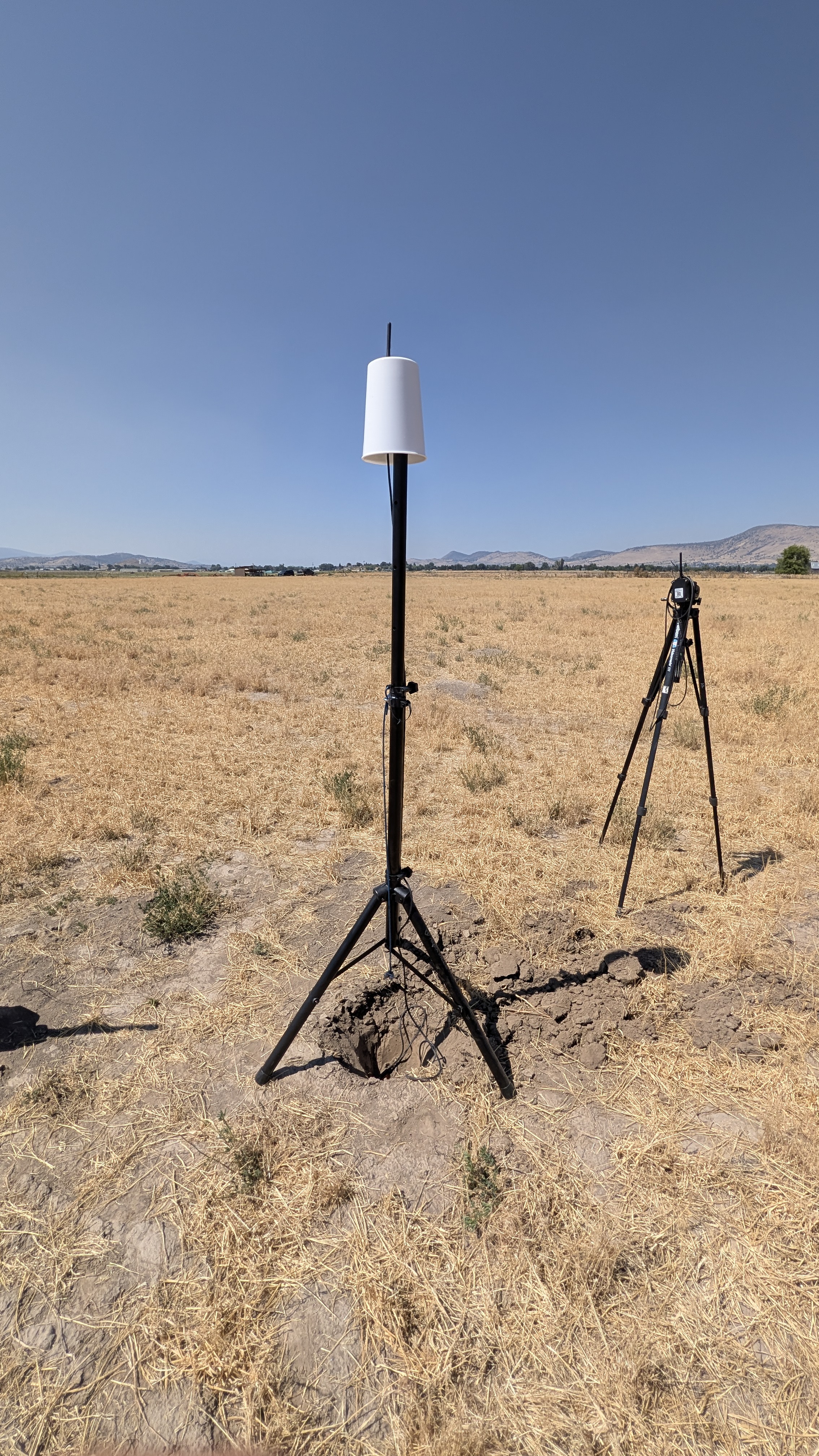
Basin Roots sensors and their field transmitters are deployed together as a complete system — not just a buried probe, but the hardware that gets readings off the farm and into the dashboard.
Sensor and transmitter deployed in one of our open fields as part of our own ongoing field testing — a real installation, not a commercial client site.
View soil moisture, soil temperature, electrical conductivity, irrigation response, and field trends through a clear client-friendly dashboard designed for phones, tablets, and computers.
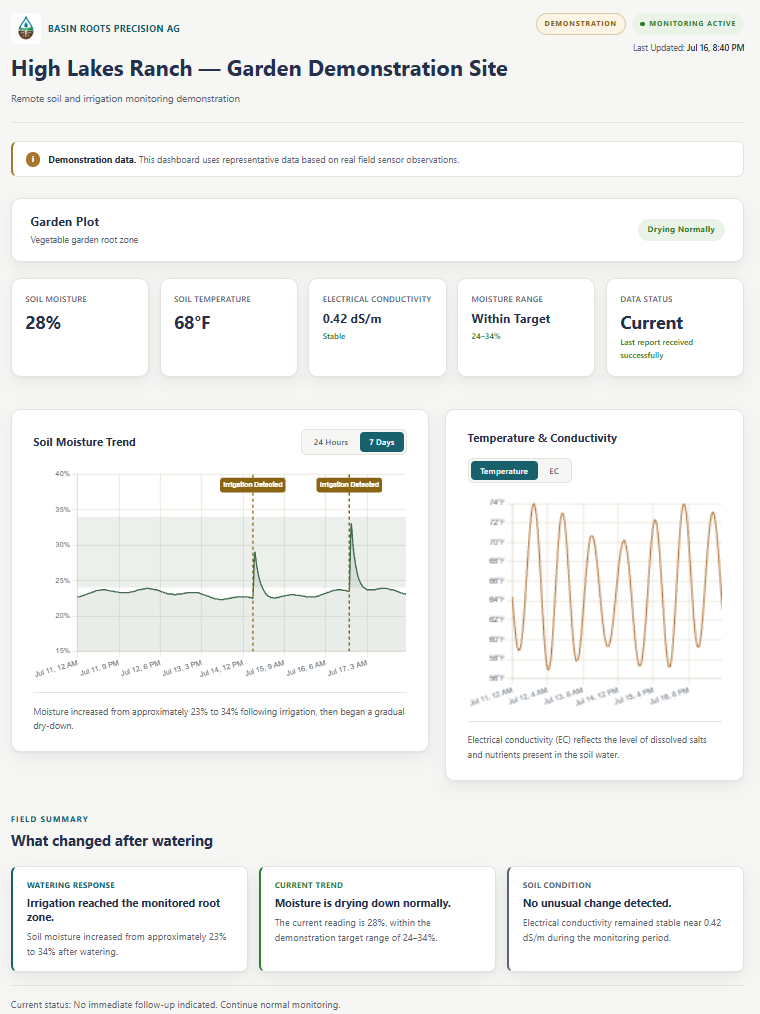
Demonstration portal using representative data based on real field sensor observations.
Basin Roots wasn't designed in an office. Every part of the system was installed, broken, fixed and improved on our own 35+ acre family farm in Klamath Falls — through a drought year, a short water season and a Klamath Basin winter.
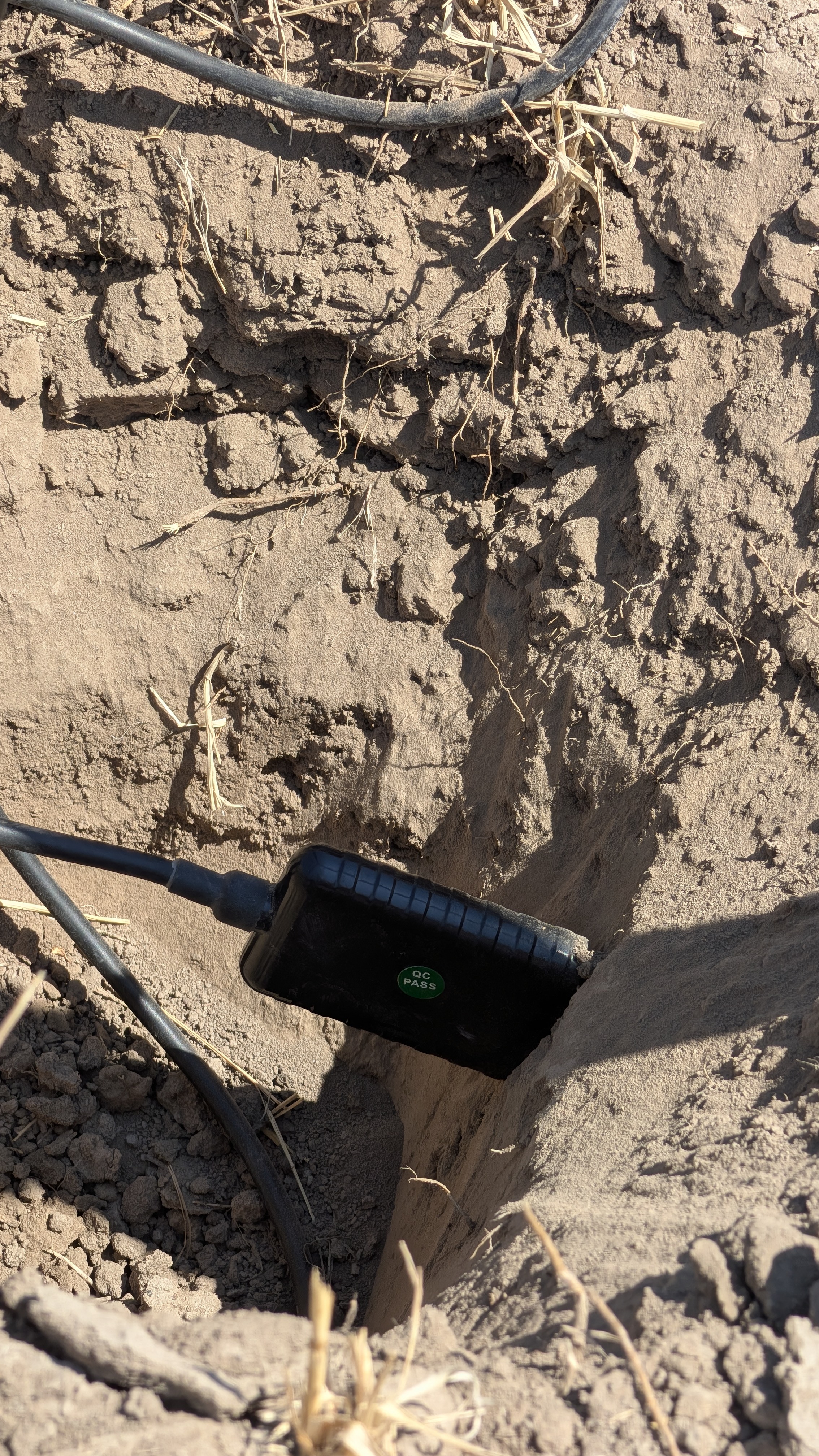
Flood-irrigated ground in a drought-prone basin, with limited water allotments and no way to see how deep each irrigation set actually soaked. We needed root-zone data to time sets with confidence.
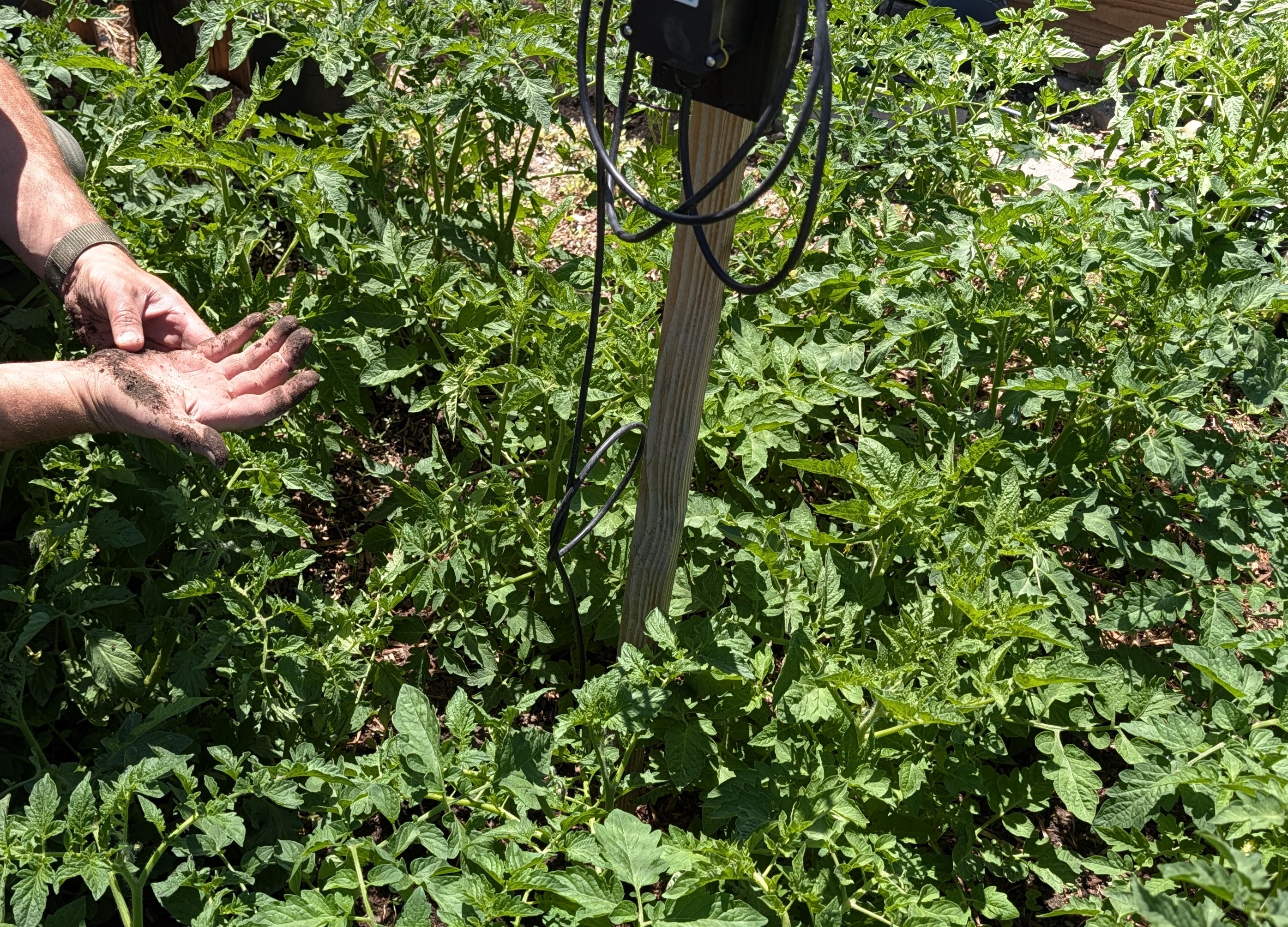
Multiple soil probes placed across the property — garden ground and open field — each reporting moisture, temperature and conductivity on a fixed interval.
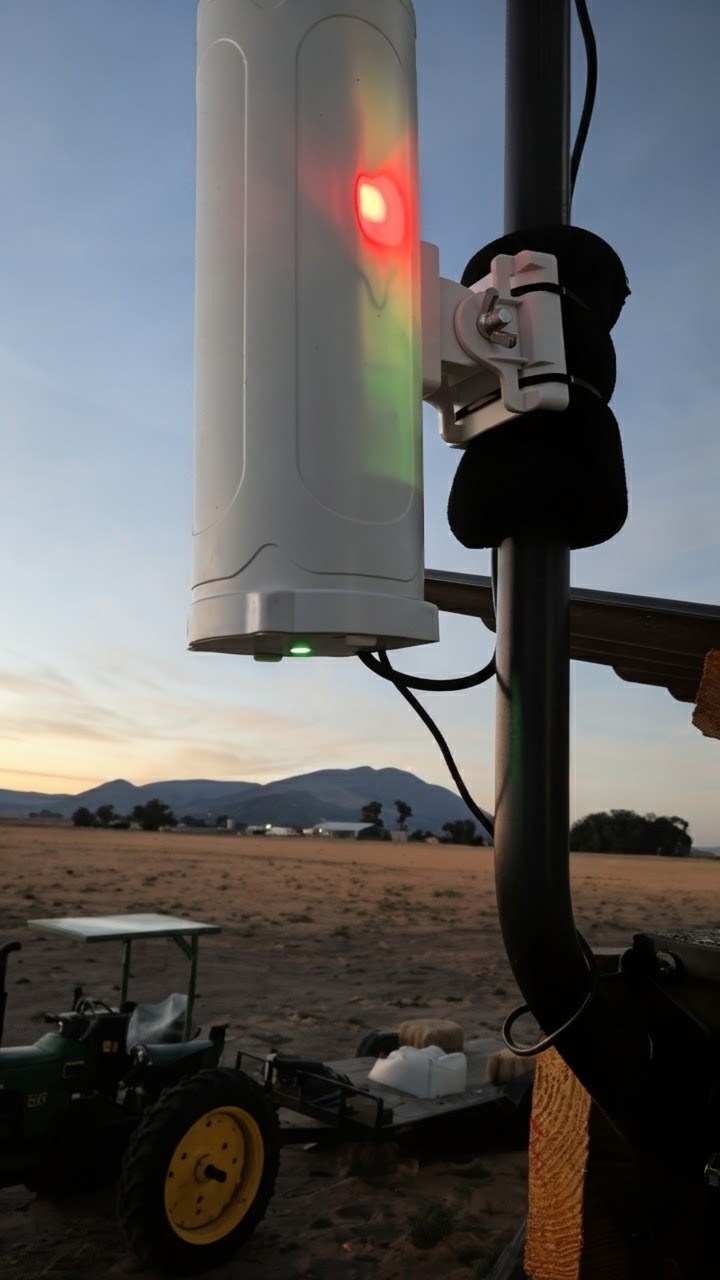
The LoRaWAN gateway and antenna mounted on the barn roof, backhauling over cellular — the farm has no wired internet at the field, which is exactly the constraint most rural operations face.
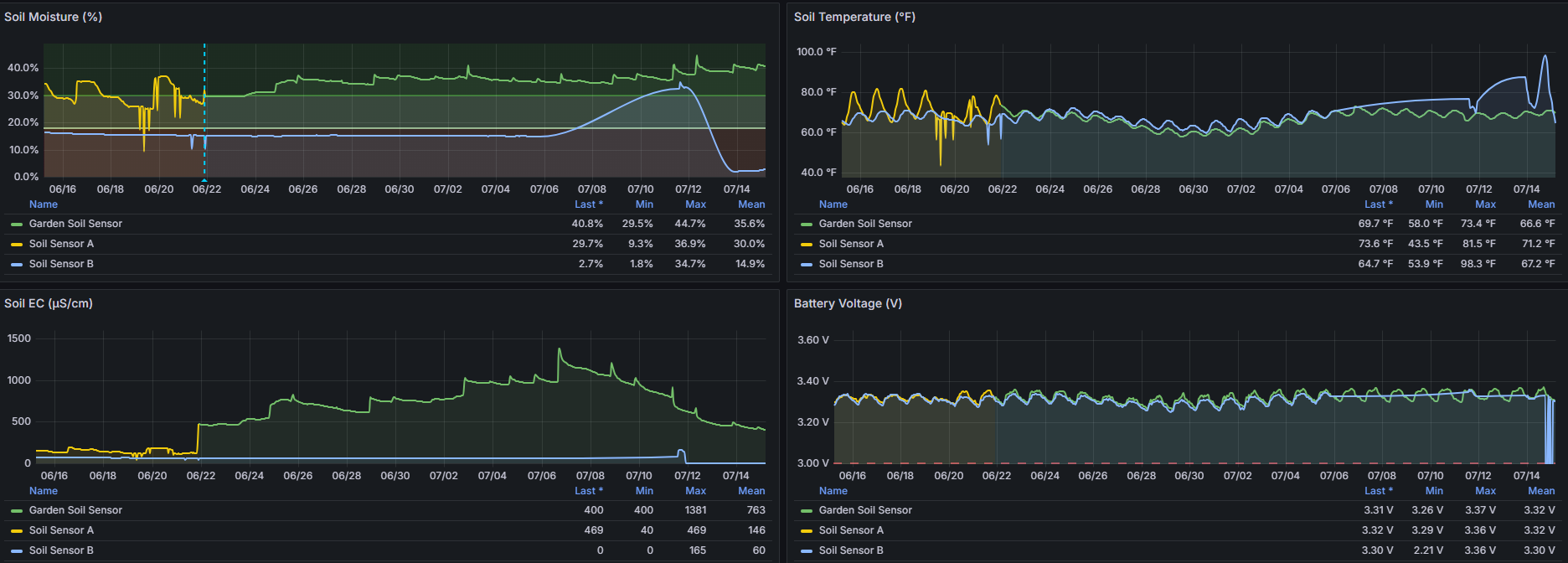
A month of side-by-side sensor history: moisture response to irrigation, daily temperature swings, conductivity trends — and battery voltage tracked on every node so hardware problems surface before data gaps do.
A year of running the system on our own ground taught us what spec sheets don't:
— Sensor placement matters more than sensor count; one well-placed probe beats three careless ones.
— Battery and delivery monitoring aren't optional — a silent sensor is worse than no sensor.
— Farmers check dashboards from a tractor cab on a phone. If it isn't readable there, it isn't useful.
Last known reading — live feed temporarily unavailable
Basin Roots is currently accepting a limited number of pilot conversations with growers, conservation partners and agricultural organizations.
Discuss a PilotTell us a little about your operation and what you'd like to see below the surface. We'll follow up to talk demonstrations, pilots and partnerships. You can also email us directly at basinroots@gmail.com, or follow along on Facebook and Instagram.